
The Imperative Of Architectural Precision In Modern E-commerce
For high-growth e-commerce enterprises operating within the Series A through C funding cycles, the margin for error in inventory management has effectively vanished. The transition from a promising startup to a market-dominant force requires more than just a functional storefront; it demands a robust framework of Product Engineering that treats inventory not as a static list of goods, but as a dynamic flow of capital and data. In the current landscape, where global markets in North America and Europe are increasingly volatile, the reliance on manual oversight or legacy systems is a structural failure waiting to manifest. Modern inventory management is no longer a back-office administrative task but a critical component of a brand’s technical architecture. As a Master Architect views a blueprint, a COO must view their inventory system as the load-bearing wall of their entire operational structure.
The core challenge lies in the increasing complexity of multi-channel retail. When an organization scales across Shopify, WooCommerce, and various third-party marketplaces, the fragmentation of data becomes a primary source of friction. This friction acts as a tax on growth, manifesting as overselling, stockouts, and inefficient capital allocation. To mitigate this, AI Automation must be integrated into the very foundation of the product. This is not merely about adding a layer of software but about re-engineering the way data moves through the organization. By applying high-performance digital infrastructure to these challenges, Sectem ensures that every SKU is accounted for with mathematical certainty. Product Engineering in this context means building systems that are not just reactive but predictive, ensuring that the growth architecture of the brand remains intact even under the pressure of rapid expansion.
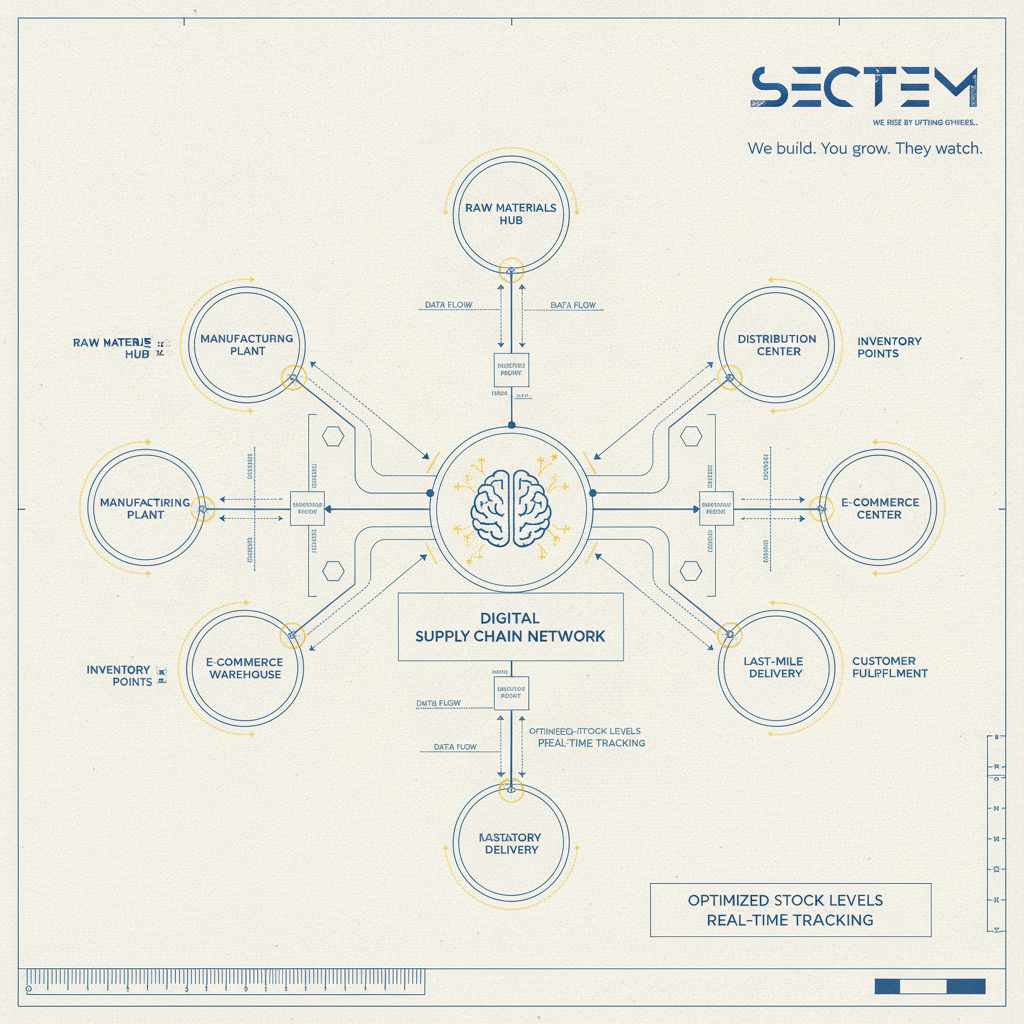
The Mechanical Failures Of Manual Inventory Oversight
Manual inventory management is a legacy approach that introduces significant risk into a scaling business. When a brand relies on human intervention to update stock levels or forecast demand, it introduces latency. In the high-stakes environment of global e-commerce, latency is equivalent to revenue loss. For a CTO or COO, identifying these manual bottlenecks is the first step toward achieving structural integrity. Manual processes are inherently non-scalable; they require a linear increase in headcount to manage a geometric increase in complexity. This is a fundamental violation of the principles of autonomous growth. When a team is bogged down by the manual synchronization of stock levels across disparate platforms like Shopify and Amazon, they are not focused on high-value architectural improvements.
Furthermore, manual oversight leads to the accumulation of technical debt. Temporary fixes, such as custom scripts that are not properly documented or integrated, eventually break. These breaks occur most frequently during high-traffic events, such as Black Friday or Cyber Monday, when the system is under the greatest stress. The failure of a manual inventory system during a peak period is not just an operational hiccup; it is a breakdown of the brand’s promise to its customers. By replacing these fragile manual systems with AI Automation, an organization can ensure that its operations are governed by logic rather than effort. This shift allows the brand to transition from a state of constant firefighting to one of controlled, intelligence-driven expansion.
AI Automation As The New Standard For Demand Forecasting
Predictive analytics, powered by AI Automation, represents the most significant advancement in inventory management in the last decade. Traditional forecasting relies on historical averages, which are often poor indicators of future performance in a rapidly changing market. AI models, however, can process vast datasets including historical sales, market trends, weather patterns, and even social media sentiment to generate highly accurate demand forecasts. This level of Data Intelligence allows a brand to optimize its inventory levels with surgical precision. For a Series B founder, the ability to reduce carrying costs while simultaneously eliminating stockouts is a direct path to improving the bottom line and increasing the valuation of the company.
The implementation of these AI models requires a deep understanding of Product Engineering. It is not enough to simply feed data into an algorithm; the data must be clean, structured, and integrated into the overall RevOps strategy. This ensures that the insights generated by the AI are actionable. For example, if the AI predicts a surge in demand for a specific category in the German market, the system should automatically trigger a reorder and adjust marketing spend to capitalize on the trend. This is the essence of autonomous growth. By removing the need for human analysis and intervention, the brand can operate at a speed that is impossible for competitors relying on traditional methods.
Integrating RevOps Into The Inventory Lifecycle
Revenue Operations, or RevOps, is the methodology of aligning sales, marketing, and customer success across the entire customer lifecycle to drive growth. In the context of e-commerce inventory, RevOps acts as the connective tissue between the warehouse and the customer. When inventory data is siloed from the rest of the organization, it creates a disconnect between what the brand is selling and what it can actually deliver. AI Automation facilitates the unification of these data streams, providing a singular source of truth for the entire enterprise. This alignment is critical for maintaining the architectural integrity of the revenue engine. When sales data informs inventory levels in real-time, the brand can maximize its ROI on every marketing dollar spent.
A well-architected RevOps framework ensures that inventory management is not viewed in isolation. Instead, it is seen as a key driver of the customer experience. If a product is out of stock, the marketing engine should automatically pivot to promote alternative items that are in high supply. This prevents the friction caused by promoting items that cannot be fulfilled. By utilizing Data Intelligence to bridge the gap between operations and revenue, brands can create a seamless experience for the customer while optimizing internal efficiencies. This is the level of precision that Sectem brings to its partners, ensuring that every component of the digital infrastructure is working in harmony to support aggressive growth targets.
The Role Of Product Engineering In Platform Orchestration
For an e-commerce brand to dominate its market, its technical foundation must support complex integrations and high-performance throughput. Product Engineering is the discipline of building these robust systems. In the modern retail environment, this often involves orchestrating a complex web of APIs between the e-commerce platform, such as WooCommerce, and the Enterprise Resource Planning (ERP) or Warehouse Management System (WMS). The structural integrity of these integrations determines the reliability of the entire business. If the bridge between the storefront and the warehouse is weak, the entire operation is at risk. AI Automation plays a vital role here by monitoring these integrations and automatically resolving discrepancies before they impact the customer.
Engineering these systems requires a focus on scalability and reliability. As a brand expands from North America into European markets, it must navigate different regulations, currencies, and logistics providers. A modular approach to Product Engineering allows for the flexible addition of new regions and partners without rebuilding the core architecture. This modularity is essential for maintaining autonomous growth. By building a high-performance digital infrastructure that can adapt to changing market conditions, Sectem provides its clients with the market dominance they require. The goal is to create a system that is so well-engineered it operates with absolute certainty, regardless of the complexity of the global supply chain.
Dynamic Pricing And Inventory Optimization
One of the most powerful applications of AI Automation in e-commerce is dynamic pricing based on inventory levels. This strategy allows a brand to adjust prices in real-time to maximize both volume and margin. When inventory is high, the system can automatically offer discounts or bundles to move stock and free up capital. Conversely, when stock is low and demand is high, prices can be adjusted upward to maximize profit on the remaining units. This level of Revenue Operations maturity is only possible when inventory data and pricing engines are perfectly synchronized through a robust digital architecture. This is not about simple rule-based changes but about sophisticated AI models that understand the elasticity of demand.
Implementing dynamic pricing requires a high degree of Data Intelligence. The system must be able to process market data, competitor pricing, and internal inventory levels simultaneously. For a CTO, the challenge is ensuring that these systems are integrated without introducing latency that could lead to pricing errors. When executed correctly, dynamic pricing turns inventory management into a strategic tool for growth. It allows a brand to be aggressive in the market while maintaining the structural integrity of its margins. This is a hallmark of a mature, intelligence-first engineering approach that separates market leaders from those who are merely participating.
Mitigating Technical Debt Through Structural Integrity
Technical debt is the silent killer of high-growth e-commerce brands. It often starts with a series of small, expedient choices made to solve immediate problems. Over time, these choices accumulate into a complex and fragile system that is difficult to maintain and nearly impossible to scale. In inventory management, technical debt often manifests as custom, brittle integrations between platforms that require constant manual intervention. To secure the future of a brand, it is necessary to address this debt through a commitment to structural integrity. This involves auditing the current tech stack and replacing fragile components with robust, AI-driven solutions that are built for the long term.
Product Engineering focused on the long term prioritizes the mechanical integrity of the outcome. This means building systems that are self-healing, well-documented, and highly performant. By investing in a high-performance digital infrastructure today, a brand can avoid the catastrophic failures that occur when a legacy system is pushed beyond its limits. Sectem’s approach is to architect solutions that not only solve today’s problems but also provide the foundation for the next decade of growth. This foresight is what allows our clients to operate with market dominance, knowing that their technical foundation is as solid as the products they sell.
Frequently Asked Questions
How does AI Automation differ from standard inventory software?
Standard inventory software is typically a record-keeping tool that tracks stock levels based on manual inputs or simple API syncs. AI Automation, however, uses machine learning algorithms to predict future stock needs, identify anomalies in data, and autonomously trigger actions like reordering or pricing adjustments. It moves the system from a passive record-keeper to an active operational intelligence engine.
What is the impact of Product Engineering on e-commerce fulfillment?
Product Engineering ensures that the technical bridge between the digital storefront and the physical warehouse is robust and high-performing. This minimizes errors in order routing, reduces the time between a customer clicking buy and the warehouse picking the item, and ensures that stock levels are updated across all channels in real-time, preventing overselling and customer dissatisfaction.
Can AI-driven inventory management help with international expansion?
Yes, AI-driven systems are essential for managing the complexity of global markets. They can account for different lead times from international suppliers, predict demand variations across different regions such as the UK and France, and manage the logistics of multiple fulfillment centers. This allows for a unified growth architecture that supports global scale without a linear increase in operational complexity.
How does RevOps integrate with inventory management?
RevOps integrates inventory management by aligning it with sales and marketing data. This ensures that marketing campaigns are only run for products with sufficient stock and that sales teams have accurate information on product availability. This alignment maximizes revenue by optimizing the flow of goods through the entire customer journey.
What are the first steps to reducing technical debt in inventory systems?
The first step is a comprehensive audit of all manual processes and custom integrations. Once these bottlenecks are identified, they should be replaced with standardized, scalable architectures that leverage AI Automation. Prioritizing structural integrity over quick fixes is essential for building a foundation that can support aggressive growth targets.

Conclusion
The transition from a high-growth startup to an industry leader requires a fundamental shift in how inventory is managed. It is no longer sufficient to treat stock levels as a logistical detail; they must be treated as a core component of the brand’s Product Engineering strategy. By integrating AI Automation and a robust RevOps framework, founders and COOs can ensure that their organizations are built on a foundation of structural integrity. This approach eliminates the bottlenecks of manual oversight, reduces the burden of technical debt, and provides the Data Intelligence necessary to dominate global markets. The mechanical integrity of your growth depends on the precision of your digital architecture.
At Sectem, we understand that your digital infrastructure is the blueprint for your success. We build high-performance products that allow you to grow autonomously while the rest of the market watches. By focusing on Architectural Integrity and Intelligence-First Engineering, we ensure that your inventory management system is not just a tool, but a high-yield digital asset. Secure your future by architecting a foundation that supports your most aggressive revenue targets and provides the market dominance you deserve.