
Introduction
In the current economic climate, the distinction between a software product and its revenue-generating capacity has dissolved. For Series A through C founders, the challenge is no longer merely building a functional application; it is the rigorous alignment of Product Engineering with Revenue Operations to create a unified growth engine. This research examines the structural evolution of digital infrastructure and how technical decisions directly dictate the efficiency of the sales funnel. When we speak of architectural integrity, we are referring to the mechanical precision with which a system captures, processes, and converts user behavior into measurable fiscal outcomes. A product that lacks this alignment is not an asset; it is a liability characterized by technical debt and operational friction.
Product Engineering in the context of high-growth SaaS and Fintech requires a departure from traditional development cycles. It demands a blueprint that accounts for the entire customer lifecycle, from initial acquisition to long-term retention. By treating the revenue stream as a core engineering requirement, organizations can transition from manual oversight to autonomous product operations. This transition is predicated on the ability to architect systems that are not only scalable but also inherently intelligent. As we navigate the complexities of global market expansion in North America and Europe, the necessity for a robust technical foundation has never been more critical. The following analysis outlines the essential components of a modern Growth Architecture and the future of research within the RevOps domain.
The Structural Convergence Of Engineering And Revenue
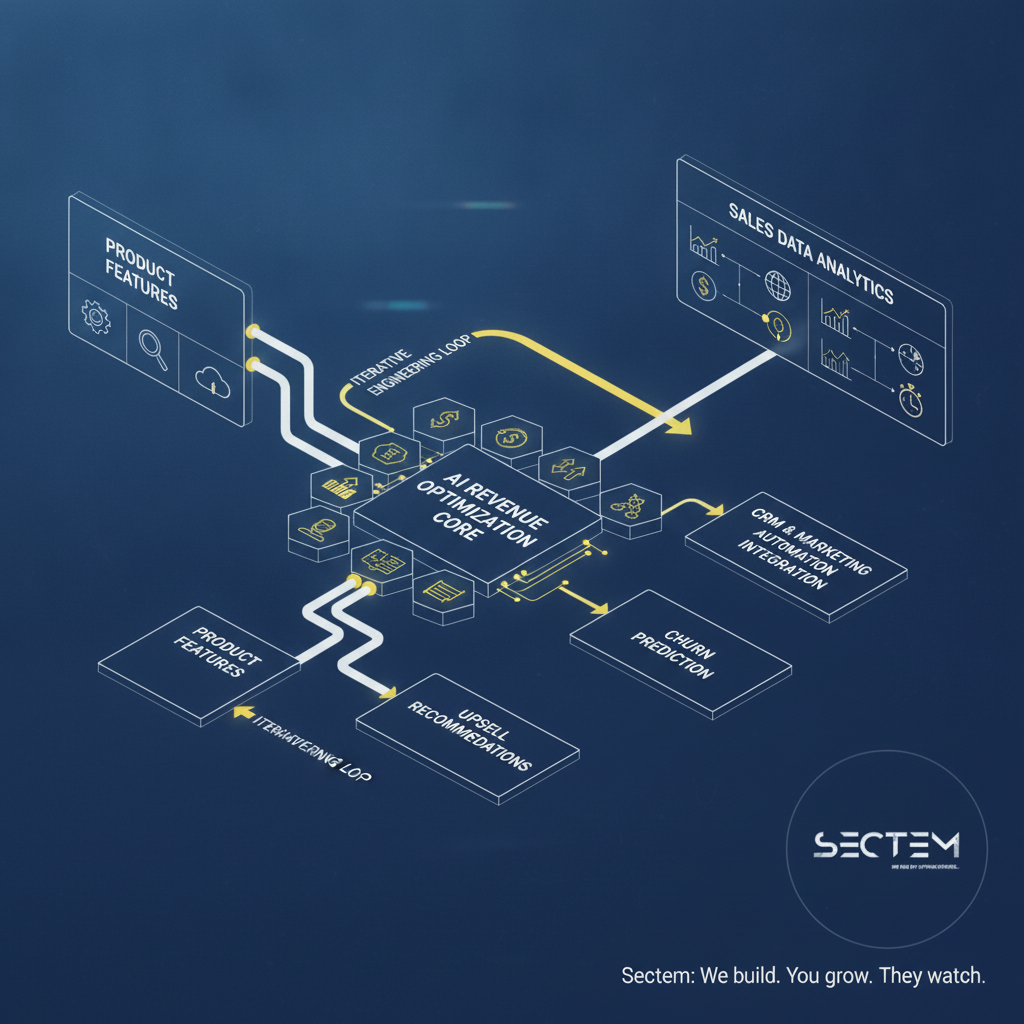
The historical silo between engineering teams and revenue teams is the primary cause of decelerated growth in scaling enterprises. Engineering focuses on feature sets and system uptime, while Revenue Operations focuses on pipeline velocity and conversion rates. However, the future of sustainable growth lies in the convergence of these disciplines. Product Engineering must now serve as the conduit for data that informs every step of the sales process. This requires a shift in how we view the codebase; it is no longer just a set of instructions for the machine, but a framework for capturing market intelligence. When engineering and revenue operations are decoupled, the result is a fragmented data landscape that prevents accurate forecasting and leads to inefficient resource allocation.
To achieve structural integrity in this convergence, founders and CTOs must implement a shared language between technical and commercial departments. This is not about soft skills or meetings; it is about the mechanical integration of CRM systems with the core product architecture. Every user interaction within the product should trigger a corresponding event in the RevOps stack, allowing for real-time visibility into the health of the revenue engine. This level of integration eliminates the manual data entry that often plagues sales operations, replacing it with a precise, automated flow of information. By architecting this synergy from the ground up, companies can ensure that their technical infrastructure supports, rather than hinders, their aggressive revenue targets.
Furthermore, the convergence of engineering and revenue allows for a more sophisticated approach to product-led growth. When the product is engineered to understand its own value delivery, it can autonomously identify expansion opportunities. For instance, a fintech platform can be architected to detect when a user reaches a specific transaction threshold that necessitates a higher-tier subscription. This is not a marketing tactic; it is a function of intelligent Product Engineering. By building these triggers directly into the digital infrastructure, organizations create a self-optimizing system that maximizes ROI without requiring constant manual intervention from the sales team.
Architecting The Revenue Engine Beyond The CRM
While the CRM is often viewed as the center of the revenue universe, a truly high-performance Growth Architecture treats the CRM as merely one node in a larger, more complex system. Relying solely on a CRM to manage revenue operations is a structural weakness that leads to data silos and blind spots. The future of Revenue Operations research points toward a decentralized yet unified model where the product itself acts as the primary source of truth. This requires a sophisticated data layer that can aggregate information from multiple sources—product usage, marketing interactions, and customer support tickets—into a singular intelligence stream. This stream then feeds the CRM, providing sales and success teams with a comprehensive view of the customer journey.
Architecting this engine requires a focus on Data Intelligence. It involves the implementation of advanced telemetry within the product to track not just what users are doing, but how those actions correlate with revenue. For example, in a logistics SaaS platform, engineering teams might track the efficiency of route optimization features. If the data shows that users who achieve a 20 percent efficiency gain are 50 percent more likely to renew, that insight becomes a critical component of the RevOps strategy. This is where Product Engineering meets revenue strategy; the engineer builds the mechanism to track the metric, and the RevOps professional uses that metric to drive growth. This level of technical oversight ensures that the business is making decisions based on hard data rather than intuition.
Moreover, the structural integrity of the revenue engine depends on its ability to handle the complexities of global markets. For companies expanding into the United Kingdom, Germany, or France, the architecture must account for regional variations in data privacy, currency, and user behavior. A centralized revenue engine that is not engineered for localization will inevitably fail. This means that the engineering team must build a flexible framework that allows for rapid adaptation to new market requirements. By architecting for global scale from the outset, founders can avoid the costly and time-consuming process of rebuilding their infrastructure every time they enter a new territory.
AI Automation And The Frictionless Customer Lifecycle
The integration of AI Automation into the revenue stack is no longer an optional luxury; it is a fundamental requirement for maintaining a competitive edge. However, the true value of AI in RevOps is not in chatbots or automated emails, but in the mechanical optimization of the customer lifecycle. This begins with the automation of repetitive manual processes that create friction in the acquisition cycle. From lead scoring to contract generation, every manual touchpoint is a potential point of failure and a source of unnecessary cost. By engineering autonomous workflows, organizations can ensure that their revenue operations are as efficient as their core technology.
In the realm of Product Engineering, AI Automation can be used to predict churn before it happens. By analyzing patterns of declining usage or specific technical errors, the system can autonomously trigger an intervention from the customer success team. This proactive approach to retention is only possible when the product and the revenue engine are deeply integrated. The goal is to create a frictionless loop where the product identifies a risk, the automation engine alerts the relevant team, and the intervention is logged and analyzed for future optimization. This is the essence of Intelligence-First Engineering: building systems that are not only reactive but also predictive.
Furthermore, AI-driven RevOps can significantly improve the accuracy of revenue forecasting. Traditional forecasting is often based on historical data and sales rep sentiment, both of which are prone to error. An AI-automated system, however, can analyze real-time data from across the entire organization to provide a much more precise projection of future growth. This allows CTOs and COOs to make informed decisions about resource allocation and capital investment. When the architecture is built to support this level of data intelligence, the organization can operate with absolute certainty, even in volatile market conditions. The focus remains on the structural integrity of the outcome, ensuring that every dollar spent on engineering contributes directly to the bottom line.
Eliminating Technical Debt To Accelerate Time To Market
Technical debt is the silent killer of revenue growth. For Series B and C companies, the pressure to release new features often leads to architectural shortcuts that compromise the long-term stability of the product. This debt eventually manifests as engineering bottlenecks, slowing down critical growth cycles and causing inconsistent product performance. In the context of Revenue Operations, technical debt translates directly into lost revenue. If the engineering team is spent 60 percent of their time on maintenance and bug fixes, they are not building the features that drive market expansion and customer retention. This is a failure of architectural integrity.
To accelerate time-to-market and secure the future of the brand, founders must prioritize the remediation of technical debt. This requires a disciplined approach to Product Engineering where structural integrity is valued as highly as feature velocity. By investing in a robust technical foundation, companies can ensure that their product is capable of supporting aggressive revenue targets without collapsing under the weight of its own complexity. This involves refactoring legacy code, automating testing protocols, and ensuring that the data architecture is scalable. A clean codebase is a prerequisite for a high-performance revenue engine.
Moreover, eliminating technical debt allows for more agile responses to market shifts. In the fast-moving SaaS and Fintech sectors, the ability to pivot or launch a new product line in response to competitor activity is a significant competitive advantage. Companies burdened by technical debt are unable to move with the necessary speed, leaving them vulnerable to market disruption. By maintaining a high standard of engineering excellence, organizations can ensure that they remain the masters of their own growth trajectory. The master architect understands that the strength of the tower depends entirely on the integrity of the foundation.
Data Intelligence And The Unified Revenue Stream
The fragmentation of data is one of the most significant challenges facing modern RevOps teams. When marketing data, sales data, and product data exist in separate silos, it is impossible to gain a clear understanding of the customer journey. This lack of visibility leads to misaligned incentives and inefficient spending. Product Engineering plays a critical role in solving this problem by architecting a unified data layer that serves as the single source of truth for the entire organization. This involves the use of sophisticated ETL (Extract, Transform, Load) processes and data warehousing solutions to ensure that information is accurate, accessible, and actionable.
Data Intelligence is the process of transforming this unified data into strategic insights. For a founder or COO, this means having a real-time dashboard that shows the exact cost of acquisition, the lifetime value of a customer, and the ROI of every engineering initiative. This level of transparency is essential for making the high-stakes decisions required at the Series C level and beyond. It allows for the precise measurement of attribution, showing exactly which product features or marketing campaigns are driving the most revenue. Without this intelligence, the organization is essentially flying blind, relying on guesswork rather than data-driven certainty.
Furthermore, a unified revenue stream enables more sophisticated customer segmentation. By analyzing product usage data in conjunction with demographic and firmographic information, companies can identify their most valuable customers and tailor their sales and marketing efforts accordingly. This precision reduces waste and increases the efficiency of the entire growth engine. In North American and European markets, where competition is fierce and customer expectations are high, this level of sophistication is a prerequisite for market dominance. The architecture must be built to handle the volume and complexity of this data, ensuring that the intelligence stream remains fast and reliable as the company scales.
Engineering For Global Market Dominance
Expansion into international markets presents a unique set of technical and operational challenges. For a SaaS company headquartered in the United States, moving into the European market requires more than just translating the user interface. It requires a fundamental shift in how the product is engineered to handle data residency, privacy regulations like GDPR, and localized payment processing. These are not merely compliance issues; they are core engineering requirements that impact the structural integrity of the revenue engine. Failure to account for these factors can lead to significant legal risk and loss of customer trust.
Product Engineering for global markets also requires a focus on performance and latency. A fintech application that works perfectly in New York must also perform flawlessly in London, Paris, and Berlin. This demands a distributed architecture that can deliver high-speed performance regardless of the user’s geographic location. By investing in edge computing and global content delivery networks, companies can ensure a consistent user experience that supports their revenue goals. This level of technical precision is what separates the market leaders from the also-rans. The master architect knows that the integrity of the system must be maintained across all geographies.
Finally, global expansion requires a localized approach to Revenue Operations. Sales cycles, buyer personas, and pricing models vary significantly between North America and Europe. The growth architecture must be flexible enough to accommodate these variations without requiring a complete rewrite of the system. This means building a modular infrastructure where regional settings can be easily adjusted to meet local market demands. By architecting for this level of flexibility, founders can scale their operations quickly and efficiently, securing their position as a global leader in their sector. The goal is absolute market dominance, achieved through the mechanical precision of engineering and the strategic intelligence of RevOps.

Frequently Asked Questions
What is the relationship between Product Engineering and RevOps?
Product Engineering provides the technical infrastructure and data capture mechanisms that allow Revenue Operations to function efficiently. Without a product engineered for data intelligence, RevOps is limited to manual processes and incomplete information. The two must be aligned to create a unified growth engine.
How does technical debt affect revenue growth?
Technical debt creates engineering bottlenecks that slow down the development of revenue-generating features. It also leads to inconsistent product performance, which increases customer churn. In short, technical debt consumes resources that should be spent on growth, directly impacting the bottom line.
Why is a unified data stream important for SaaS companies?
A unified data stream eliminates data silos, providing a clear and accurate view of the entire customer journey. This allows for more precise revenue forecasting, better customer segmentation, and a more accurate understanding of the ROI of marketing and engineering initiatives.
How can AI Automation improve revenue operations?
AI Automation can eliminate repetitive manual tasks, predict customer churn, and provide more accurate revenue forecasts. By automating the mechanical aspects of the revenue funnel, organizations can focus their human capital on high-value strategic initiatives.
What are the technical challenges of global market expansion?
Global expansion requires engineering for data residency, privacy compliance, and localized performance. It also demands a flexible revenue architecture that can adapt to different pricing models and buyer behaviors across different regions, such as North America and Europe.
Conclusion
The future of revenue operations is inextricably linked to the integrity of product engineering. For the high-growth enterprise, the product is no longer just a service; it is the primary engine of revenue and the most valuable source of market intelligence. Achieving market dominance requires a commitment to architectural integrity, ensuring that every line of code contributes to a stable, scalable, and autonomous growth framework. By eliminating technical debt and embracing intelligence-first engineering, founders and CTOs can transform their digital infrastructure into a high-yield asset that operates with absolute certainty.
As we have explored, the convergence of these disciplines is not merely a trend but a structural necessity. The ability to unify fragmented data, automate complex workflows, and architect for global scale is what defines the next generation of market leaders. Sectem remains dedicated to providing the foundational technology and intelligence that allows enterprises to navigate these challenges and secure their future. The blueprint for growth is clear: build with precision, scale with intelligence, and maintain the structural integrity of the outcome at all costs. The world is watching; ensure your architecture is ready for the spotlight.